Comparison
Jewellery stand vs jewellery box: which storage suits you
Open jewellery stands and holders or closed boxes and cabinets? Dust, tarnish, tangles, space, which pieces suit each and practical storage ideas.
A jewellery stand keeps pieces on show and within reach, while a jewellery box or cabinet keeps out dust and limits the air that reaches them. Neither is better for everything. Put what you wear every week on a stand or holder, and keep silver you rarely wear, pearls and valuable pieces in a closed box. This guide compares the two, matches each type of jewellery to the right option and ends with storage ideas for small rooms.
Open and closed storage: what counts as which
Open storage is anything that leaves jewellery in the air of the room:
- jewellery stands, from necklace busts and T-bars to folding screens,
- jewellery trees with branches for rings and chains,
- a jewellery holder for one type of piece, such as a ring cone or an earring frame,
- wall organisers with hooks, mesh or pegboard,
- dishes and open trays.
Closed storage shuts pieces away behind a lid, door or drawer front:
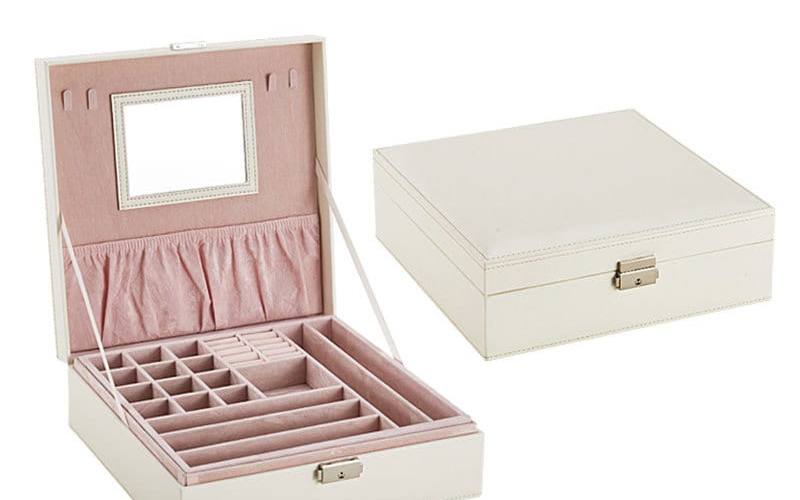
- jewellery boxes with trays, ring rolls and drawers,
- jewellery cabinets, from tabletop to free-standing,
- lined drawer inserts in a chest of drawers,
- pouches and small sealed bags.
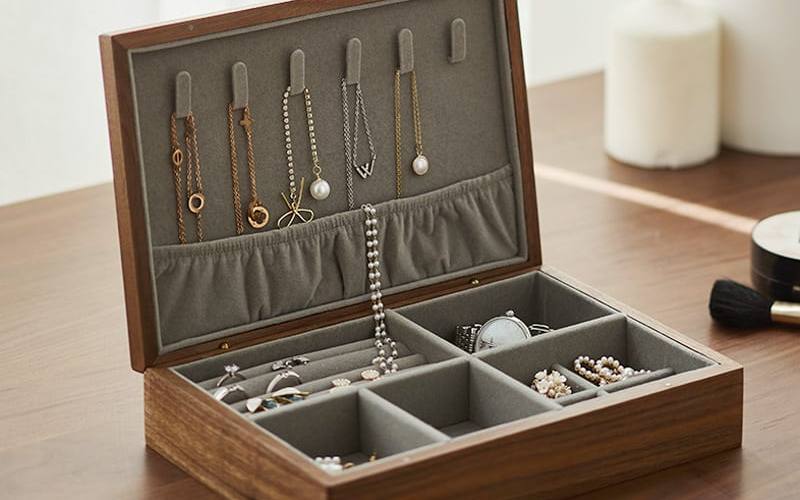
Some pieces sit in between. Our earring and necklace cabinet shows earrings on clear panels like a stand, but closes like a small wardrobe. Our walnut jewellery box hangs necklaces from six hooks in the lid, so chains hang straight inside a closed box.
Side by side
| Open: stand, holder, wall organiser | Closed: box, cabinet, drawer | |
|---|---|---|
| Dust | Settles on pieces and on velvet panels | Lid or doors keep most of it off |
| Air reaching silver | All the time | Much less, and less again with an anti-tarnish strip |
| Tangles | Chains hang straight, one per hook | Chains knot if piled together |
| Seeing what you own | Everything at a glance | You open lids, trays and drawers to look |
| Space | Needs a clear surface or a wall | Fits on a shelf, in a drawer or under a mirror |
| Curious hands | Easy for children and pets to reach | Lid or doors in the way, and some boxes lock |
Dust, tarnish and light
The main difference between open and closed storage is air. The Canadian Conservation Institute (CCI), which advises museums on caring for their collections, explains that the dark layer is mainly black silver sulphide, formed by sulphur compounds in the air. The CCI makes prevention in sealed containers or display cases a priority, and says silver should be kept free of dust.
A jewellery box is not airtight, but it does cut down how much air moves past your pieces. A stand cannot. That does not rule out silver on a stand: silver you wear and wipe every week is handled often enough. Silver you wear twice a year belongs in a box. Our guide on how to store jewellery explains humidity, anti-tarnish strips and the materials to keep away from silver.
GIA's jewellery care tips add two points that matter for open storage:
- jewellery should never be tossed into a drawer or on top of a dresser, and the box or pouch a piece came in is a good place to keep it,
- light and heat can fade or damage some gems, such as amethyst, kunzite, topaz and shell cameos.
So keep a stand away from a sunny windowsill and from radiators, and give stones like these a closed home.
Tangles and seeing what you own
Open storage wins on tangles. A chain hanging from its own hook cannot knot around another, and drop earrings hanging from a lattice stay in pairs. You also see everything at once, which makes it easier to remember pieces you own.
Closed storage only avoids tangles if the inside is laid out for chains: hooks in the lid, or long compartments with one chain in each. A box with a few square sections and a pile of necklaces is where knots start. Our guide on how to choose a jewellery box explains which compartments suit which pieces.
Which pieces suit which option
| Piece | Open stand or holder | Closed box or cabinet |
|---|---|---|
| Everyday chains and pendants | Yes, one per hook, clasp closed | Lid hooks or long compartments |
| Long necklaces | Only if the stand is tall enough for them to hang free | Long compartments or lid hooks with room below |
| Stud earrings | Lattice or panel with holes, backs on | Earring panels or a grid of small squares |
| Drops and hoops | Yes, on a lattice or bar | Deeper compartments |
| Rings | A ring holder for the ones you wear daily | Ring roll, with a diamond ring in its own slot |
| Watches | Not ideal | A cushion in a box, face up |
| Silver you rarely wear | No | Yes, with an anti-tarnish strip |
| Pearls | No | Yes, in a soft pouch |
| Light-sensitive stones | Not in sunlight | Yes |
Two of those rows rest on GIA advice. For rings, GIA's diamond care guide notes that only a diamond can scratch a diamond, and that a diamond can also scratch precious metal settings. For pearls, GIA advises storing them in a soft pouch or case, away from sharp or rough objects and out of hot, dry places.
Space: where each one fits
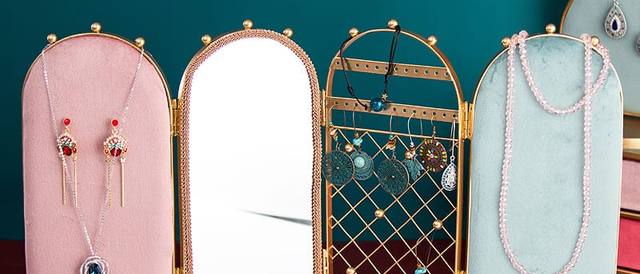
- Dressing table: a stand needs a clear strip of surface. Our folding velvet jewellery stand is about 50 x 12 x 33 cm opened out, with a mirror panel, a metal lattice for earrings and two padded velvet-look panels, and it folds flat when you need the space.
- Narrow spots: a tall, slim cabinet uses height instead of width. Our earring cabinet is 235 mm tall and takes up only 115 x 65 mm. At that height it suits short and medium chains; very long necklaces are better in a box.
- Under a mirror or on a shelf: a low box fits where a stand will not. Our walnut box is about 8 cm high.
- Walls and doors: hooks and earring frames on a wall free the surface completely. If you rent, check what your tenancy allows before you drill.
Use both: a simple setup
Most collections work best split in two:
- On the stand: this week's earrings, two or three everyday chains and the bracelets you reach for most.
- In the cabinet or box: the rest of your earrings, rings in a ring roll and necklaces on lid hooks or in long compartments.
- Shut away: silver you rarely wear in a small bag with an anti-tarnish strip, pearls in a soft pouch, and anything valuable or sentimental.
Swap pieces between the stand and the box when the season or your outfits change. Everything gets worn, and nothing sits out in the air for months.
Practical jewellery storage ideas
- Hooks inside a wardrobe door. Chains hang straight, and the door keeps light and most dust off.
- Lined trays in a drawer. Closed storage that takes no surface space at all. Measure the inside of the drawer, including its height, before you buy trays.
- A landing spot by the bed. A ring holder or a small lined tray where rings go every night, so they are never left loose on a bare surface.
- Clear bags for rarely worn silver. Label them and keep them inside a box, so you can see what is there without opening each bag.
- Earrings by type. Studs on panels with holes, drops and hoops on a lattice or bar. Pairs stay together and you can see gaps at once.
- Keep it out of the bathroom. Steam from baths and showers makes the air damp. Our guide on how to store jewellery explains why that matters for silver.
Whatever mix you choose, our jewellery organisers cover the open side and our jewellery boxes the closed side, and each product page lists the supplier's size and materials.
Frequently asked questions
Is it better to store jewellery on a stand or in a box?
It depends on the piece. A stand suits jewellery you wear every week: you can see it, reach it and chains hang straight. A closed box or cabinet suits silver you rarely wear, pearls and anything valuable, because it keeps out dust and limits the air that reaches the metal. Most people get the best result by using both.
Do jewellery stands make silver tarnish faster?
The stand itself does not cause tarnish. Tarnish forms when sulphur gases in the air react with silver, and on a stand the silver is open to that air all the time. Keep silver you wear often on the stand and wipe it before you hang it up, and keep silver you rarely wear in a closed box with an anti-tarnish strip.
What is the difference between a jewellery stand, a jewellery holder and a jewellery organiser?
The words overlap. A stand is usually a free-standing display with arms, hooks or panels. A holder is anything that holds one type of piece, such as a ring cone or an earring frame. Organiser is the widest term and also covers trays, drawer inserts and small cabinets.
Can I keep pearl necklaces on a jewellery stand?
It is better not to. The Gemological Institute of America (GIA) advises storing pearls in a soft pouch or case, away from sharp or rough objects, and not in hot, dry places. A pouch inside a closed box does that, while metal hooks and lattices on an open stand do not.
How can I store jewellery in a small space?
Go upwards and inwards. Use the wall or the inside of a wardrobe door for hooks and earring frames, choose a tall cabinet with a small footprint for earrings, and put lined trays inside an existing drawer. A low box under a mirror uses space that is often wasted.